Some towns you just see, and some you really live. If you're wondering what to see in Estepona, we can tell you now it's the second kind. You might arrive thinking about the beach and end up losing a whole afternoon among colourful flowerpots, giant murals and squares where the neighbours still bring their chairs out to the front door. We know it well, because we've been watching Estepona go by from the same spot on Calle Caridad since 1962.
In this guide we tell you what to see in Estepona, at an easy pace and with real affection: the places you can't miss, the ones that often go unnoticed, how to plan a visit of one or two days and, of course, where to sit down for food that tastes of the real Andalusia. It's written by people who live here and know these streets by heart.
Estepona in a nutshell
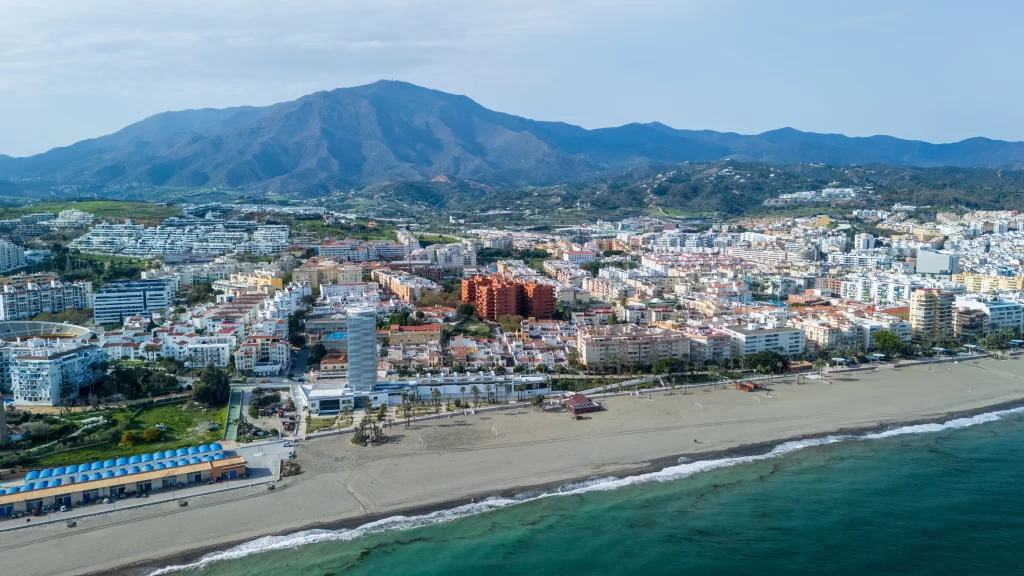
Estepona sits at the western end of the Costa del Sol, about 82 kilometres from Málaga city, between Marbella and Casares. It has just over 20 kilometres of coastline, mountains behind it rising to 1,450 metres and an old town that has been looked after like few others in the province.
According to the Andalusian Institute of Statistics and Cartography, 79,593 people lived in the municipality in 2025, 22,778 of them foreign nationals. You notice the mix on the street: you'll hear English, German, Dutch or Swedish in the bakery queue, but life in the centre still keeps its old rhythm, with Mass, the market and a mid-morning beer.
Estepona is known as the Garden of the Costa del Sol. It isn't an empty slogan: over the last decade the town council has renovated more than 130 streets, pedestrianised much of the centre and covered the façades in flowers. In 2021 alone, more than a million flowers were planted around the town.
15 must-sees in Estepona
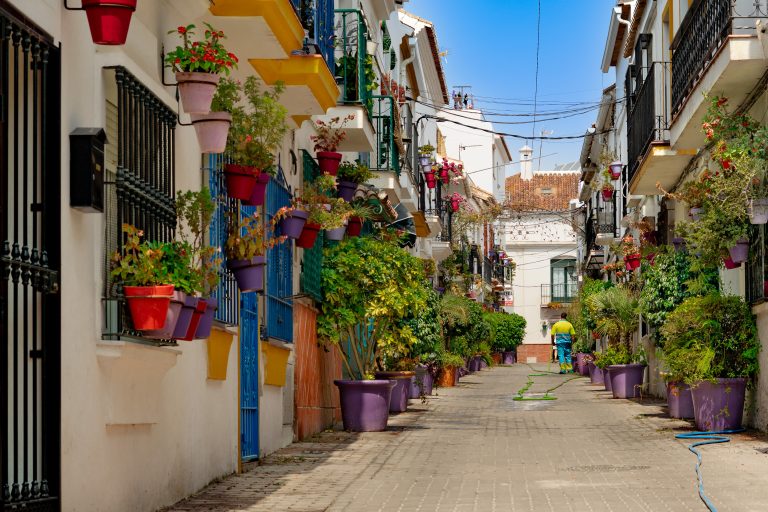
1. The old town and its flower-filled streets
Let's start with the most photographed part. Estepona's old town is a friendly maze of white streets, window grilles, painted flowerpots and cobbled paving. Each street has flowerpots of a different colour, so a stroll almost becomes a game: the street with the blue pots, the red ones, the yellow ones.
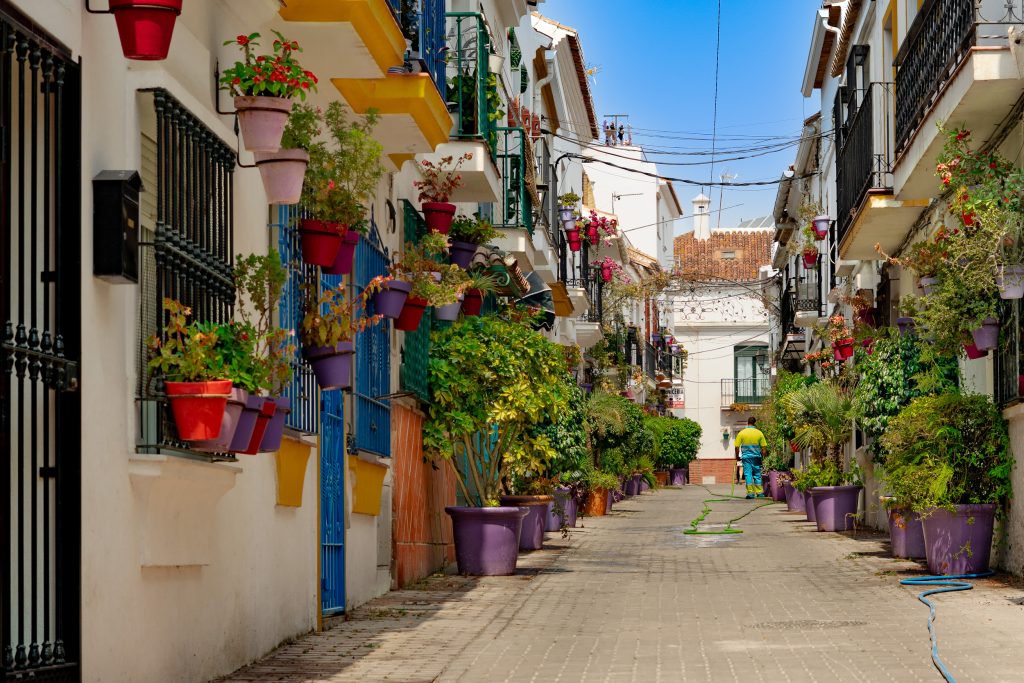
Our advice: don't rush, and don't keep your phone in your hand the whole time. Look at the older neighbours sitting in their doorways, peek into the patios left open and let yourself wander. You can walk the whole old town in a couple of hours, but it's best enjoyed over an afternoon.
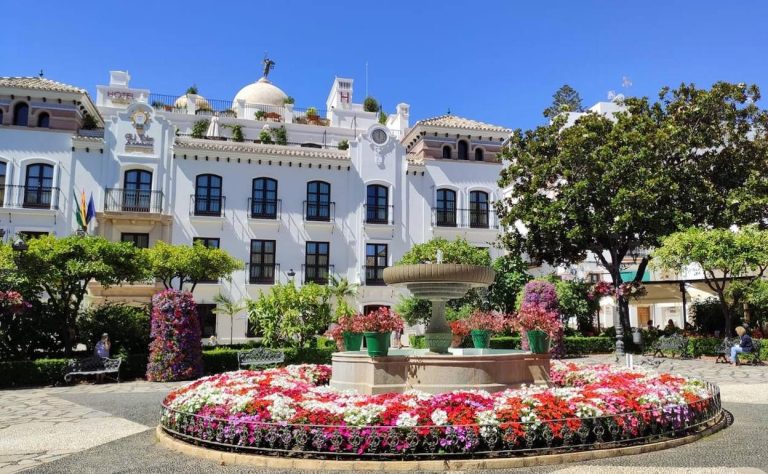
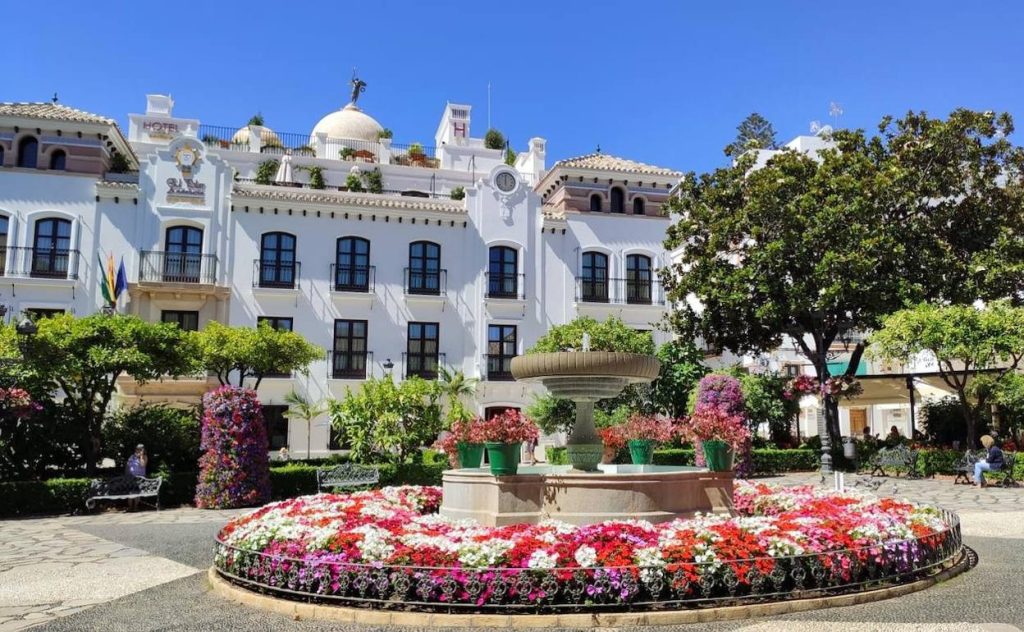
2. Plaza de las Flores
This is the social heart of the centre. It was laid out in the 19th century, when Estepona began to grow eastwards, and the most important houses of the time were built here. It has changed its name several times depending on which way the political wind was blowing: Plaza Nueva, Plaza de la Cárcel, Plaza de la Constitución, Plaza del Rey. Today it's simply Plaza de las Flores.
Here you'll find the central fountain, the Casa de las Tejerinas and the Tourist Office, where you can pick up the map of the murals and the poetry route. If you visit in summer, it's where half the town meets up as the evening falls.
3. The Clock Tower and Plaza del Reloj
It's one of Estepona's oldest symbols. It was part of the town's old main church, built after the Christian conquest in the 15th century, and the top section you see today was added in the 18th century. Local tradition links it to an old minaret from the Moorish period. Either way, it's a must-stop to understand where the town comes from.
4. San Luis Castle
Only the walls remain of the fortress that protected Estepona from attacks from the sea, but since December 2024 you can visit the inside as an exhibition centre. It was built in the last quarter of the 16th century to strengthen the coastal defences and went through a lot: the Lisbon earthquake of 1755 and demolitions by French troops in 1812. In its first year open it welcomed more than 34,500 visitors. Inside you'll see artillery ammunition, ceramics, religious objects and even a Civil War air-raid shelter.
5. The Church of Nuestra Señora de los Remedios
Its entrance is one of the most unusual in the province, mixing Baroque with details reminiscent of colonial architecture. It was built in the 18th century, and its tower, topped with two-coloured tiles, can be seen from many corners of the old town. If it happens to be open, it's worth popping in.
6. The Murals Route
Estepona is now an open-air street art museum, with more than 60 numbered murals spread around the town. Some are huge: «Día de Pesca», by José Fernández Ríos, covers about 1,000 square metres across six façades and is considered the largest mural in Spain by surface area. There's also a mural in braille, one dedicated to the Spanish fir and another with a 30-metre lighthouse near the harbour.
The route is free and you can do it at any time. The central part takes an hour and a half to two hours; the full route is more like half a day. The best photos are early in the morning or at sunset.
7. The Poetry Route
While you're looking for murals you'll come across verses on the walls. Estepona has hung poems by writers such as Antonio Machado and Rafael Alberti on its façades, many of them in several languages. It's one of those small things that make a walk stick in your memory. By the way, inside El Típico Andaluz we've also kept old poems and posters on the walls, so in a way the route carries on with us.
8. The Orchid House Botanical Park
It opened on 28 March 2015 and it's one of the town's great sources of pride. Under three glass domes, the largest 30 metres high, it holds more than 5,000 plants and around 1,300 species of orchid, the largest collection in Spain. There's a 15-metre waterfall, vertical gardens and a bamboo forest. Entry costs 3 euros for adults and 1 euro for children. It's the perfect plan for a rainy day or the hottest hours.
9. Mirador del Carmen
It opened on 30 March 2023 on Avenida de España, facing the sea, and the building sums up how the town has changed: a vertical library, music conservatory, auditorium, exhibition hall with works from the Carmen Thyssen collection and a viewing tower overlooking the Mediterranean. On top there's a pedestrian square of more than 15,000 square metres that works like a balcony over the sea. Go up the tower on a clear day and you'll see Gibraltar and, if you're lucky, the coast of Africa.
10. The bullring and its museums
Estepona's bullring opened in 1972. It was designed by the architect Juan Mora Urbano and is billed as the world's first asymmetrical bullring. Its first impresario was the bullfighter Antonio Ordóñez, from Ronda, who gives his name to the Bullfighting Museum you can visit inside: matador costumes, posters, cattle brands and photos of bullfighters from every era. Entry is free, Tuesday to Saturday mornings.
In the same building is the Museo del Mar (Sea Museum), opened in November 2025 and expanded in 2026 with an immersive room that recreates the posidonia seagrass meadows off Estepona's coast. If you like bullfighting culture, you'll see why our walls are covered in posters and bullfighting memorabilia.
11. The fishing port and marina
Estepona has never stopped being a seaside town. At dawn the purse-seine boats come back and sell at the fish market; in the afternoon, between 17:30 and 19:00, the catch from trawlers, trammel nets and longlines is auctioned. Next door, the marina has a lively bar scene and, on Sunday mornings, a market selling local produce and crafts.
12. The seafront promenade and La Rada beach
La Rada is Estepona's town beach: wide, easy to get to and with a long, well-kept promenade. If you feel like walking further, the Senda Litoral coastal path lets you cover several kilometres of coastline on foot or by bike. At sunset it's one of the best free things to do in town.
13. Los Reales de Sierra Bermeja
Behind Estepona lies one of the most unusual landscapes in Europe. Los Reales de Sierra Bermeja has been a protected Natural Site since 1989. It rises to 1,450 metres and is home to about 90 hectares of Spanish fir, a relic of the last ice age that grows here on peridotite, the reddish rock that gives the mountains their name. From the top you can see the whole Strait. It's half an hour's winding drive, so it's worth setting aside a morning.
14. Casa de las Tejerinas and 19th-century corners
Around Plaza de las Flores there are still 19th-century manor houses with ironwork, balconies and doorways that tell you what farming and trading Estepona was like. They're not postcard monuments, but they help you understand how the town grew before tourism.
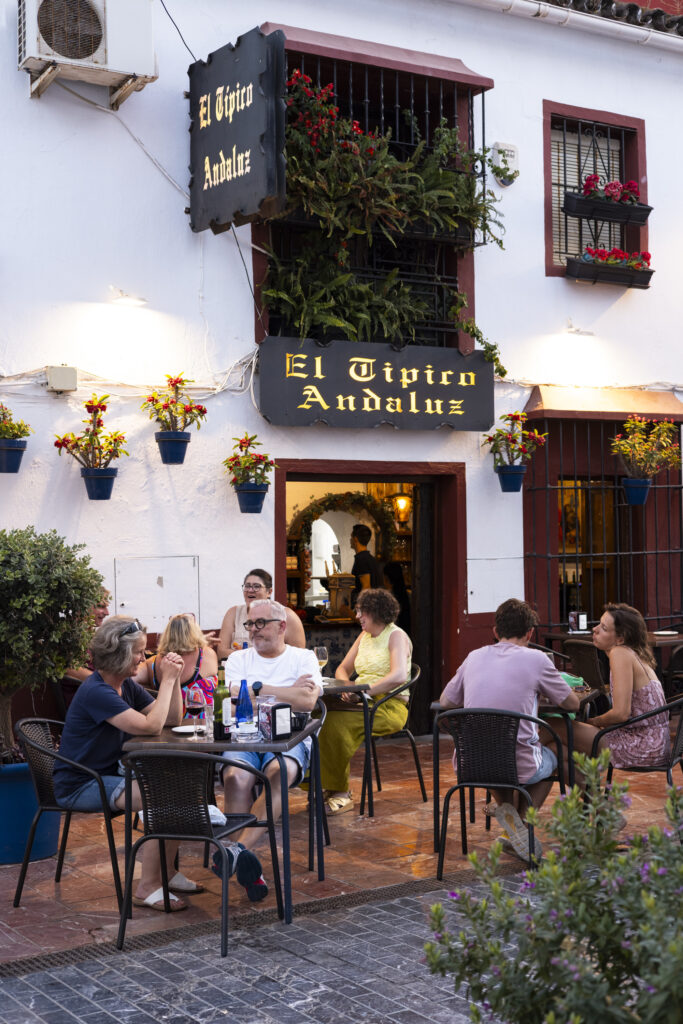
15. A stop full of history on Calle Caridad: El Típico Andaluz
And now it's time to talk about home. On Calle Caridad, right in the old town, you'll find El Típico Andaluz. According to the older folk in the neighbourhood, the building was an inn in the 18th century, when this area was on the edge of town. The bar opened here in 1962, and it was the first one on Calle Caridad.
Couples who are now in their seventies met here, thousands of plates have been shared here over the decades and the queues here are still remembered by half of Estepona. In December 2025 we reopened after a renovation that respected everything of value: the façade, the thick walls, the arches, the posters, the old poems and the collection of knives worn down by so many years of carving.
It isn't just a place to eat. It's a piece of the old town's history you can visit with a beer in your hand. If you'd like the full story, we tell it in our article on the history of El Típico Andaluz.
What to see in Estepona in one day
If you only have one day, this is the route we'd recommend to a friend:
- Morning: breakfast in the centre and a stroll through the old town. Plaza de las Flores, the Clock Tower, the Church of los Remedios and San Luis Castle.
- Mid-morning: the Orchid House and the first murals in the centre.
- Midday: lunch on Calle Caridad. A board of Iberian cured meats, some homemade croquettes and a dressed tomato with tuna belly, in the shade and in no hurry.
- Afternoon: the bullring and Bullfighting Museum (in the morning if you go Tuesday to Saturday), or head down to the Mirador del Carmen.
- Sunset: walk along the La Rada promenade to the harbour.
- Evening: back to the old town for a tapas dinner. The flower-filled streets have a different charm at night.
What to see in Estepona in two days
With two days you can do the route above at a gentler pace and add the full murals route, the Senda Litoral and a morning at Los Reales de Sierra Bermeja. If you're here on a Sunday, don't miss the market at the harbour. And if you're staying in the centre, treat yourself to a long dinner, the kind where you linger at the table, on a terrace in the old town.
When to visit Estepona
Estepona has good weather almost all year round, but every season has its charm.
- Spring: the best time for the flower-filled streets. At Easter the religious brotherhoods process through the centre, and in May there's the pilgrimage of San Isidro, the town's patron saint.
- Summer: beach life and fiestas. In 2026 the town's main fair and festivities took place from 7 to 12 July, and on 16 July the Virgen del Carmen is taken out to sea with the fishermen.
- Autumn: mild temperatures, fewer people and the best time for the mountains.
- Winter: the town belongs to the locals. Christmas lights in the centre, tables that are easy to get and the perfect plan for a long weekday lunch.
If you can choose, we'd recommend avoiding August. The old town is much more enjoyable without the crowds, and in the bars in the centre we can look after you at a more relaxed pace.
Things to do in Estepona with kids
Estepona is a great place to visit as a family. Hunting for colourful streets and murals is a game kids love, and the Orchid House, with its waterfall and bamboo forest, is usually a sure hit. They'll love the immersive room that recreates the seabed at the Museo del Mar, and at the harbour they can see the fishing boats up close.
To run around and burn off energy, the La Rada promenade and the Senda Litoral are perfect. And when it's time to eat, nothing beats a terrace in the old town where the grown-ups try a stew and the kids are won over by homemade croquettes or potatoes. At El Típico Andaluz, families of four to eight are some of our most regular customers.
FAQs about what to see in Estepona
What is the prettiest part of Estepona?
The old town, with its streets full of colourful flowerpots, Plaza de las Flores and the Murals Route. That's what sets Estepona apart from the rest of the Costa del Sol.
How much time do you need to see Estepona?
In one day you'll see the essentials. With two days you can add the full murals route, the coast and the mountains.
Can you get around Estepona on foot?
Yes. The old town, the promenade, the Orchid House, the bullring and the harbour are all within walking distance. For Sierra Bermeja you'll need a car.
Where can I eat in Estepona's old town?
On Calle Caridad you'll find El Típico Andaluz, open since 1962, with Iberian ham, Andalusian tapas and classic home cooking. We're open every day.
What can you do in Estepona when it rains?
The Orchid House, San Luis Castle, the Bullfighting Museum, the Museo del Mar, the exhibitions at the Mirador del Carmen and, of course, a good meal indoors somewhere with history.
Come and see us on Calle Caridad
Seeing Estepona without sitting down to eat in its old town is only doing half the job. We're waiting for you at El Típico Andaluz with our Iberian ham, our house croquettes and a corner of the town's history you won't find anywhere else.
- Address: C. Caridad, 55, 29680 Estepona, Málaga
- Phone and bookings: 663 746 370
- Kitchen: 13:00 to 16:00 and 19:00 to 00:00, every day